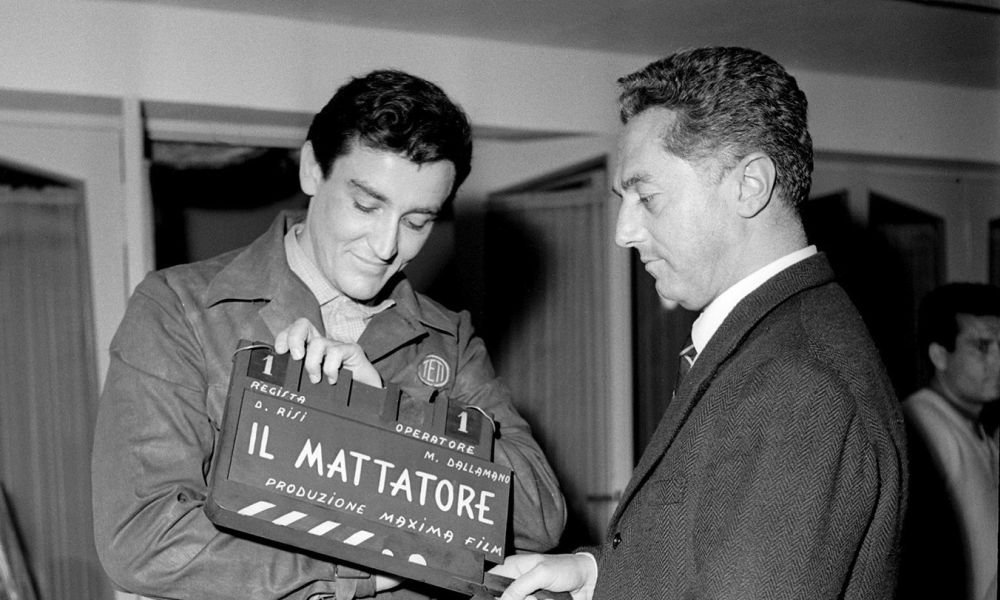
"His specialty is the Neapolitan-style bittersweet humor, casting a cynical, winking eye on unwholesome aspects of life in contemporary Italian society, the rich as well as the poor. An enormously prolific director, he has collaborated on the stories and screenplays of most of his own films, whose robust buffoonery often thinly veils serious social satire." - The Film Encyclopedia, 2012
Dino Risi
Director / Screenwriter
(1916-2008) Born December 23, Milan, Lombardy, Italy
(1916-2008) Born December 23, Milan, Lombardy, Italy
Key Production Countries: Italy, France
Key Genres: Comedy, Drama, Romance, Satire, Dark Comedy, Mystery-Suspense, Romantic Comedy, Crime, Comedy Drama, Horror
Key Collaborators: Vittorio Gassman (Leading Actor), Alberto Gallitti (Editor), Armando Trovajoli (Composer), Ruggero Maccari (Screenwriter), Adriano De Micheli (Producer), Pio Angeletti (Producer), Alfio Contini (Cinematographer), Ugo Tognazzi (Leading Actor), Agenore Incrocci (Screenwriter), Ettore Scola (Screenwriter), Furio Scarpelli (Screenwriter), Mario Cecchi Gori (Producer)
Key Genres: Comedy, Drama, Romance, Satire, Dark Comedy, Mystery-Suspense, Romantic Comedy, Crime, Comedy Drama, Horror
Key Collaborators: Vittorio Gassman (Leading Actor), Alberto Gallitti (Editor), Armando Trovajoli (Composer), Ruggero Maccari (Screenwriter), Adriano De Micheli (Producer), Pio Angeletti (Producer), Alfio Contini (Cinematographer), Ugo Tognazzi (Leading Actor), Agenore Incrocci (Screenwriter), Ettore Scola (Screenwriter), Furio Scarpelli (Screenwriter), Mario Cecchi Gori (Producer)
"It is a curious twist of fate that Dino Risi became a film director at all. After graduating in psychiatric medicine and originally practising as a psychiatrist, Risi fell into moviemaking almost by chance. Perhaps it took a psychiatrist to probe the psyche of Italian film culture in the way Risi ultimately did. By the end of the director's film adventures he had worked in all the key postwar Italian genres, absorbing and recrafting neorealism, social neorealism, pink neorealism and, later, giving a hard filmic centre to Italy's commedia all'italiana tradition." - Russ Hunter (501 Movie Directors, 2007)
"Dino Risi’s comedies are a devilish piece of work, lampooning the politicians, playboys, and priests of postwar Italy. Together with Mario Monicelli, Luigi Comencini, and Ettore Scola, Risi enjoyed tremendous commercial and critical success during “Il Boom,” the Italian economic miracle of the 1950s and 1960s. At his best, Risi was a caricaturist in the vein of Honoré Daumier, using exaggerated grotesqueries to sweeten the bitterness of his social satire. His films are populated by a rogue’s gallery of shamelessly lovable commedia all’Italiana types in the inimitable guises of some of the era’s greatest actors: Alberto Sordi, Vittorio Gassman, Nino Manfredi, Ugo Tognazzi, and Sophia Loren." - The Museum of Modern Art, 2016
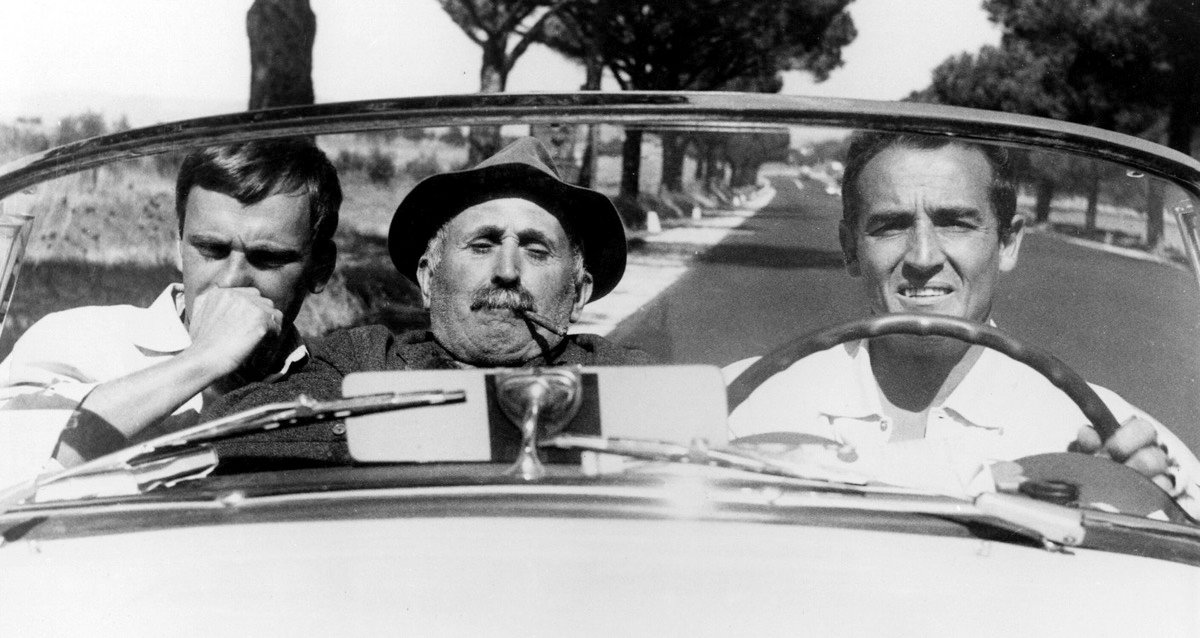
Il Sorpasso (1962)
"He became interested in cinema in Milan and studied film in Switzerland while interned there during World War II. He had already made friends with directors Mario Camerini and Alberto Lattuada who gave him work as an assistant director… It was his third feature, Il Segno di Venere, a comedy starring Sophia Loren, that really launched his career. Since then he has become one of Italy's major directors with films that gently and humorously observe life." - The Illustrated Who's Who of the Cinema, 1983
"The title "maestro of Italian film comedy" was one that Dino Risi shared with Mario Monicelli… Along with the late Pietro Germi, who made (1961), they created the genre which became known as "comedy Italian style", a considerable improvement on the average Italian comic films of the time. Even if Risi's 1974 film Profumo di Donna (Scent of a Woman), with Vittorio Gassman as man trying to come to terms with his blindness, was perhaps his greatest international success (winning him an Oscar nomination for its screenplay and a Hollywood remake with Al Pacino) it was his 1962 comedy, also starring Gassman, Il Sorpasso (The Easy Life), which was to become a cult movie. It is among the films that most reflected the mood of its times, in this case the social malaise behind the Italian economic "miracle" of the 1960s." - John Francis Lane (The Guardian, 2008)
"His best films contain acid depictions of those whose quest is material comfort, success, or the good life with an amoral enthusiasm. Such studies are further animated by humor (The Success, 63; The Easy Life, 63)." - William R. Meyer (The Film Buff's Catalog, 1978)
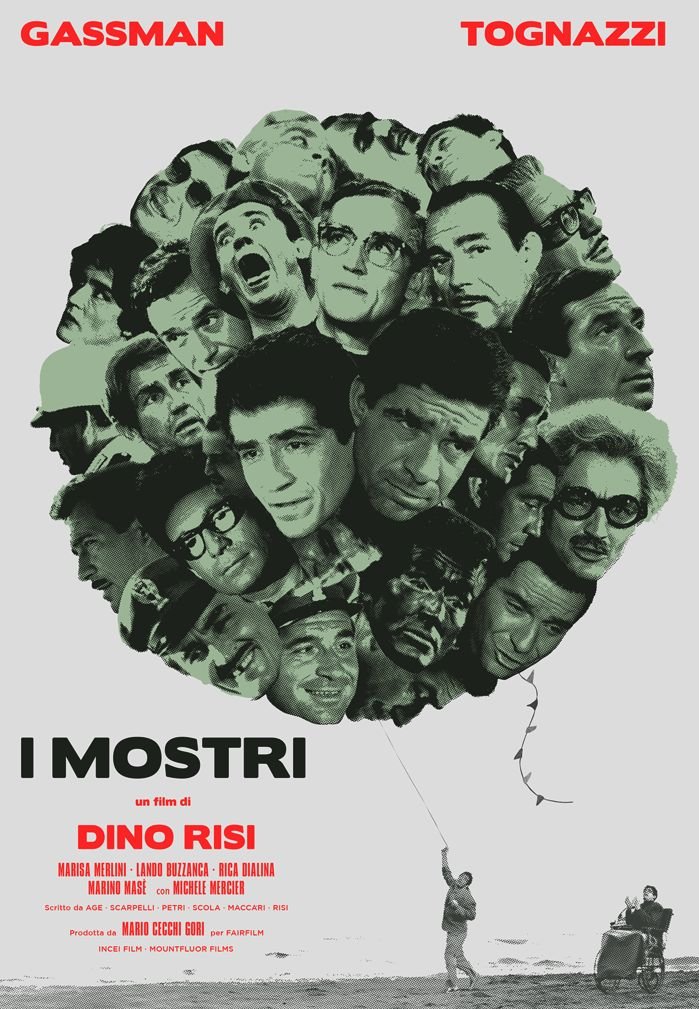
"Mr. Risi’s most productive period was the 1960s, when commedia all’italiana, as practiced by Mr. Risi and other filmmakers like Pietro Germi, Mario Monicelli, Ettore Scola and Luigi Comencini enjoyed an international reputation. His films during this period included Una Vita Difficile (A Difficult Life, 1961), starring Alberto Sordi; La Marcia su Roma (March on Rome, 1963), set during the formative years of Italian Fascism and starring Gassman and Ugo Tognazzi; and I Mostri (retitled Fifteen From Rome, 1963), perhaps Mr. Risi’s most ambitious film, a scathing look at the new materialism of the 1960s told in comic vignettes." - Dave Kehr (The New York Times, 2008)
"There is a brief but telling scene in Dino Risi’s Il Sorpasso (The Easy Life, 1962) that encapsulates his vision as a film-maker. In it, Vittorio Gassman’s playboy parks his racer illegally, and then casually tucks under the windscreen wiper the parking ticket from a neighbouring car so as to avoid getting a fine himself. The gesture’s mix of elegance, bravado and cunning are for Risi both the best and worst of his fellow Italians’ characteristics, and emblematic too of the country’s postwar transformation from the values of a traditional society to those of consumerism." - The Times, 2008
Selected Filmography
Loading filmography...
Dino Risi / Favourite Films
City Lights (1931) Charles Chaplin.
Source: Sodankylä Ikuisesti: Desert Island Films (1996)
City Lights (1931) Charles Chaplin.
Source: Sodankylä Ikuisesti: Desert Island Films (1996)
Dino Risi / Fan Club
Grégory Valens, Michel Mourlet, Richard Dyer, Paolo Mereghetti, Michael Baute, Guillaume Brac, Gian Luca Farinelli, Gérard Legrand, Lorenzo Codelli, Jacques Goimard, Bruno Bozzetto, Martin Scorsese.
Grégory Valens, Michel Mourlet, Richard Dyer, Paolo Mereghetti, Michael Baute, Guillaume Brac, Gian Luca Farinelli, Gérard Legrand, Lorenzo Codelli, Jacques Goimard, Bruno Bozzetto, Martin Scorsese.
"Fan Club"
These film critics/filmmakers have, on multiple occasions, selected this director’s work within film ballots/lists they have submitted.
These film critics/filmmakers have, on multiple occasions, selected this director’s work within film ballots/lists they have submitted.