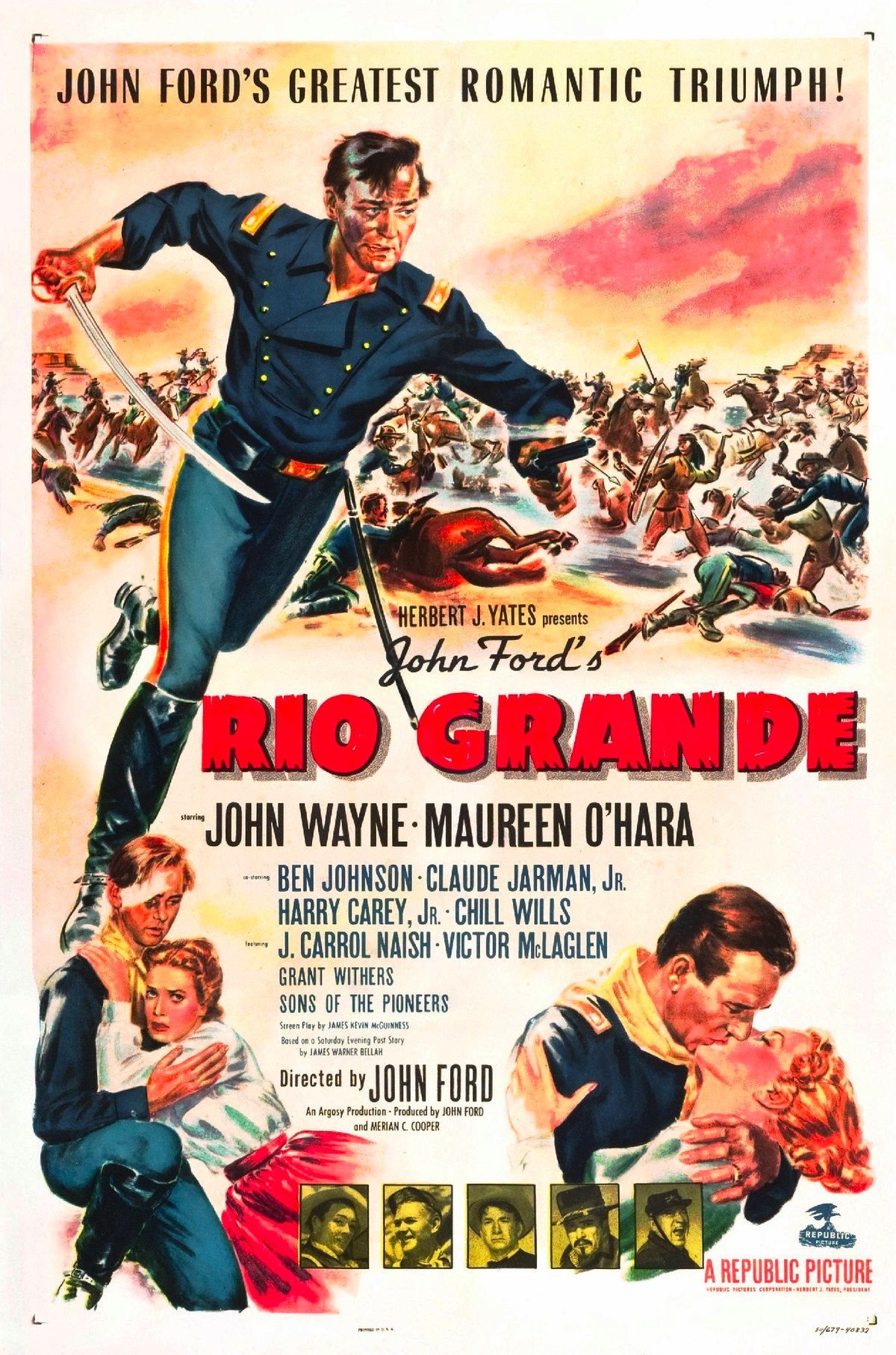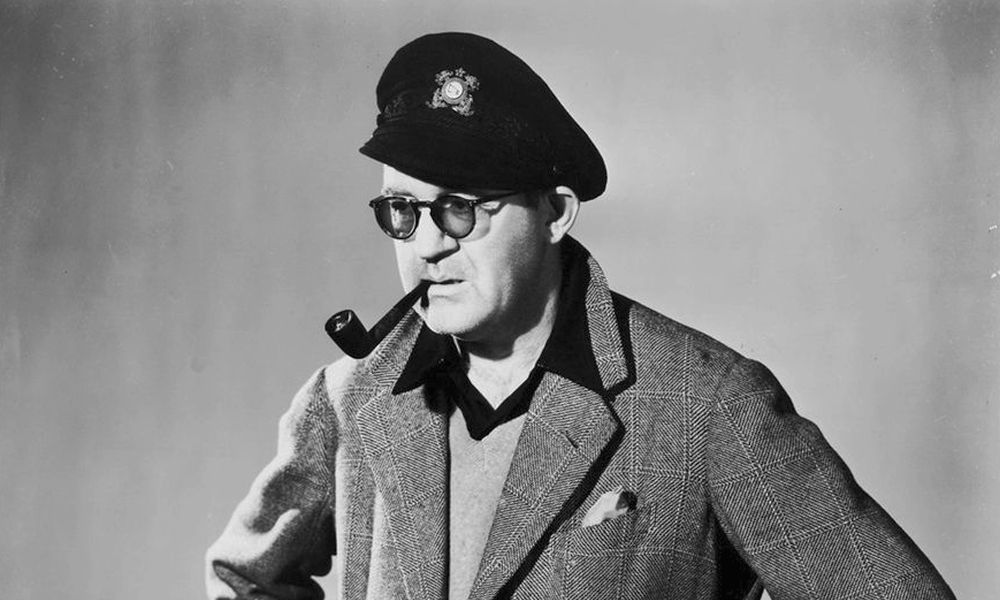
"Pre-eminent Hollywood director and the chief architect of the pioneer (specifically, Western) tradition in American films. Although tethered to the Hollywood studio system for the greater part of his career, he has achieved a thematic consistency which informs even the unlikeliest of his films and distinguishes his greatest." - Margaret Hinxman (The International Encyclopedia of Film, 1972)
John Ford
Key Production Country: USA
Key Genres: Drama, Western, Traditional Western, Adventure, Biography, Cavalry Film, Romance, Rural Drama, Epic Western, Revisionist Western, War, Historical Film
Key Collaborators: Ward Bond (Character Actor), Jack Murray (Editor), John Wayne (Leading Actor), Dudley Nichols (Screenwriter), Frank S. Nugent (Screenwriter), John Carradine (Character Actor), George Schneiderman (Cinematographer), Alfred Newman (Composer), Bert Glennon (Cinematographer), James Basevi (Production Designer), Harry Carey Jr. (Character Actor), Anna Lee (Character Actress)
Key Genres: Drama, Western, Traditional Western, Adventure, Biography, Cavalry Film, Romance, Rural Drama, Epic Western, Revisionist Western, War, Historical Film
Key Collaborators: Ward Bond (Character Actor), Jack Murray (Editor), John Wayne (Leading Actor), Dudley Nichols (Screenwriter), Frank S. Nugent (Screenwriter), John Carradine (Character Actor), George Schneiderman (Cinematographer), Alfred Newman (Composer), Bert Glennon (Cinematographer), James Basevi (Production Designer), Harry Carey Jr. (Character Actor), Anna Lee (Character Actress)
"Orson Welles called John Ford the greatest "poet" the cinema has given us. He is at the very least the US's greatest historian (his films having examined virtually every era from the Revolutionary War to Vietnam) and his landscape surpasses that of say a Remington. His images of the individual dwarfed by this landscape, of family and community huddled against the brutality (and primal beauty) of Monument Valley in The Searchers is unsurpassable. It is not necessarily a true history, but as Ford says in The Man Who Shot Liberty Valance, "when the legend becomes truth, print the legend." John Ford was more than a filmmaker. He was a legend." - Richard Franklin (Senses of Cinema, 2002)
"Although even his greatest films are marred by broad slapstick humour and sentimental interludes, Ford nevertheless elevated the popular idiom to express his own complex, ambivalent, sometimes tragic sense of the tensions between tradition and progress, personal liberty and social justice, duty and desire. Ford was a stylist who moved the camera unobtrusively, and came to prefer simple, eye-level set-ups. Yet his unerring eye for composition and light - as well as the graceful, patient tempo he insisted upon - could infuse a seemingly straightforward scene with great delicacy and feeling." - Tom Charity (The Rough Guide to Film, 2007)
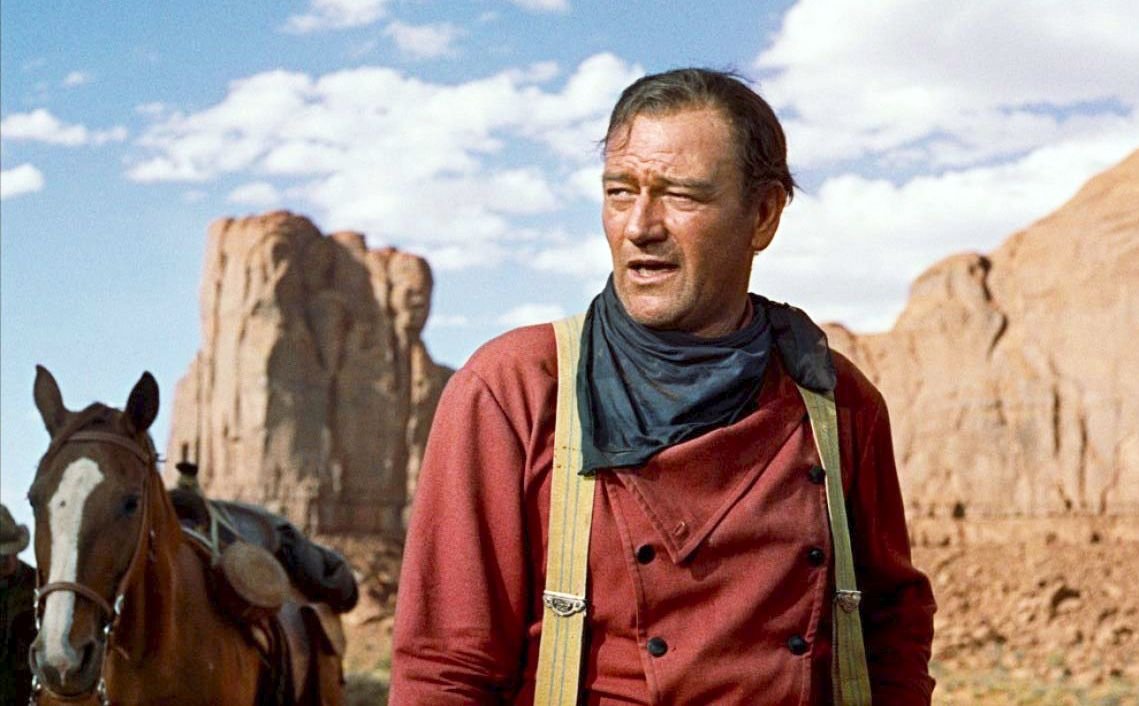
The Searchers (1956)
"In portraying, throughout a long and prolific career, the history of the United States from the Revolutionary War to World War II, Ford continually resorted to a deeply, personal, nostalgic form of legend. If there is no doubt of his importance to the development of the Western, his uniquely sentimental, poetic glorification of the white American's conquest of the wilderness is both picturesque and reactionary." - Geoff Andrew (The Film Handbook, 1989)
"While a handful of Ford’s pictures were contemporary, he generally preferred the refuge of the past – all the better to allegorise modern concerns. Any one of his films will give an immediate impression of his pictorial mastery and the peerless balance in his compositions. But digesting his films en masse allows the weight of his reputation, and the indisputable authorship of his filmography, to emerge out of his recurring preoccupations: social justice, community, order, ritual and myth. His work also reveals an unwavering empathy for the everyman and the underdog, as embodied in the revolving cast of familiar faces drawn from his stock company of recurring players." - Matthew Thrift (BFI, 2021)
"Ford developed his craft in the twenties, achieved dramatic force in the thirties, epic seep in the forties, and symbolic evocation in the fifties. His style has evolved almost miraculously into a double vision of an event in all its vital immediacy and yet also in its ultimate memory image on the horizon of history… A storyteller and poet of images, he made his movies both move and be moving." - Andrew Sarris (The American Cinema, 1968)
"There are few figures in cinema history (perhaps only C.B. DeMille is a credible challenger) who have come to define the popular conception of the film director as wholly as John Ford. The notoriously irascible eyepatch-sporting monolith who essentially created the film Western as we know it, and made John Wayne the ultimate icon of twentieth century American masculinity along the way, is as central to Hollywood’s historical landscape as the sandstone buttes are to the vista of his beloved Monument Valley." - Jessica Kiang (IndieWire, 2015)
"Belligerent, grandiose, deceitful and arrogant in real life, Ford seldom let these traits spill over into his films. They express at their best a guarded serenity, a sceptical satisfaction in the beauty of the American landscape, muted always by an understanding of the dangers implicit in the land, and a sense of the responsibility of all men to protect the common heritage." - John Baxter (International Dictionary of Films and Filmmakers, 1991)
"Throughout his long and prolific career, he was an affectionate, patriotic chronicler of US history and the mythology of how the West was won." - Chambers Film Factfinder, 2006
"Emotionalism is a strong factor in many of Ford's films which, in his later days, showed a nostalgic longing for things past and old values. These may only have existed in Ford's eyes or hazy recollection, but nonetheless they make for skilfully appealing entertainment." - David Quinlan (Quinlan's Illustrated Guide to Film Directors, 1983)
"John Ford was a consummate professional, largely indifferent to the critical acclaim he began to receive late in his career… Working within a system where he sometimes had little choice about projects, Ford was usually able to make something interesting out of bad scripts and poorly chosen casts." - R. Barton Palmer (501 Movie Directors: A Comprehensive Guide to the Greatest Filmmakers, 2007)
"Widely regarded as one of America's greatest directors, it is appropriate that John Ford got his start in that most American of genres, the Western. His career spanned over fifty-years, from the mid-teens through the mid-60s, and encompassed a variety of pictures, although he will always be best known for his Westerns." - Joel W. Finler (The Movie Directors Story, 1985)
"Themes of courage, loyalty, rugged individualism, and the American spirit pervade the films of John Ford. The natural vistas in his Westerns hold a romantic view of history with the earmarks of poetic realism. Ford very well may be the greatest director of Westerns in cinema history." - William R. Meyer (The Film Buff's Catalog, 1978)
"John Ford was an iconic American film director, best known today for his westerns, though none of the films that won him the Academy Award for best direction—The Informer (1935), The Grapes of Wrath (1940), How Green Was My Valley (1941), and The Quiet Man (1952)—were of this genre. His films, whether westerns or in other genres, are notable for a turn-of-the-20th-century ideal of American masculinity—loyal, self-deprecating yet competent, dependable in a scrap, bound by duty, courtly if somewhat tongue-tied with the ladies, with a winking fondness for alcohol but no patience for foul language or sloppy behaviour. Because of their popularity (as well as the continued popularity of many of the actors whose careers Ford helped spawn) and the skill he brought to their creation, his films had a powerful influence on Americans’ conception of their own history and values." - Encyclopaedia Britannica
"I have respected John Ford from the beginning. Needless to say, I pay close attention to his productions, and I think I am influenced by them." - Akira Kurosawa
"I have never thought about what I was doing in terms of art, or "this is great", or "world-shaking", or anything like that. To me it was always a job of work - which I enjoyed immensely - and that's it." - John Ford
Selected Filmography
Loading filmography...
John Ford / Favourite Films
The Alamo (1960) John Wayne, The Birth of a Nation (1915) D.W. Griffith, Going My Way (1944) Leo McCarey, The High and the Mighty (1954) William A. Wellman, The Honor System (1917) Raoul Walsh, Lady for a Day (1933) Frank Capra, Ninotchka (1939) Ernst Lubitsch, The Song of Bernadette (1943) Henry King, Tol'able David (1921) Henry King, 3 Godfathers (1948) John Ford.
Source: Cinema (1964)
The Alamo (1960) John Wayne, The Birth of a Nation (1915) D.W. Griffith, Going My Way (1944) Leo McCarey, The High and the Mighty (1954) William A. Wellman, The Honor System (1917) Raoul Walsh, Lady for a Day (1933) Frank Capra, Ninotchka (1939) Ernst Lubitsch, The Song of Bernadette (1943) Henry King, Tol'able David (1921) Henry King, 3 Godfathers (1948) John Ford.
Source: Cinema (1964)
John Ford / Fan Club
Andrew Sarris, José Luis Guarner, Martin Scorsese, Peter Bogdanovich, Bertrand Tavernier, Fernando Méndez-Leite, Edward Buscombe, Miguel Marías, Joseph McBride, Carlos F. Heredero, Eduardo Torres-Dulce, Dan Sallitt.
Andrew Sarris, José Luis Guarner, Martin Scorsese, Peter Bogdanovich, Bertrand Tavernier, Fernando Méndez-Leite, Edward Buscombe, Miguel Marías, Joseph McBride, Carlos F. Heredero, Eduardo Torres-Dulce, Dan Sallitt.
"Fan Club"
These film critics/filmmakers have, on multiple occasions, selected this director’s work within film ballots/lists that they have submitted.
These film critics/filmmakers have, on multiple occasions, selected this director’s work within film ballots/lists that they have submitted.